MEMO
TO: Professor Julie Spilker
FROM: Erin Grant
DATE: 28 January 2023
SUBJECT: Research Proposal “Learning to Love Learning in all methods”
PURPOSE
I hope that my research will reveal definitional variations in the terms “learning”, “education”, and “intelligence,” across different teaching methods. I hope to explore five different teaching methods: public, private, Montessori, charter, and home schools to understand their teaching philosophies, mission statement, and assessment methods. Further, I hope to consider how closely established measures of success align with the schools’ definitions of learning. I hope to prove that alternative forms of schooling can be as effective, if not more effective, than public school. I also hope to show that, while academic assessments are informative, intelligence is immeasurable. My research will show how testing is applied across variations in teaching methods and the impact it has on student placement and educational outcomes. My issue questions are:
- What is [each school’s definition of] learning? Does the school philosophy establish a difference between “learning,” “Intelligence,” and “education”? (Letteri, Demille)
- How do definitions of learning differ across methods? (Goldberg).
- What are the established and accepted forms of assessing (testing) learning achievement across methods? (originstutoring)
- How well do established methods of testing reflect students’ cognitive development? (Letteri)
- How well do established methods of testing reflect the school’s definition of learning or academic success? (Robinson, Learning Revolution and Do Schools Kill Creativity).
- In other words, how do schools define learning, how do they teach it, how do they know that their teaching methods work? (Adey).
BACKGROUND
I am passionate about learning. Not just learning, but learning well: learning to love learning, learning to think, learning to ask questions. When I was in elementary and high school, this wasn’t the case. I struggled in every class and in every subject. I barely squeaked out a high school diploma. Somewhere along the lines, someone sold me on the idea that intelligence is inherent—either you have it, or you don’t, and I didn’t think I had it. It wasn’t until college, and I was influenced by my English 111 professor that I started to think differently about my own intelligence—my talents, how to learn, how to think, how to analyze, how to study. I wasted a lot of time and energy when I was young thinking I was not smart. I know I am not alone in this thought process. I have talked to many people who don’t think they are smart, or who struggled in school only to find later that learning is possible for them. I feel that part of the problem is the over emphasis on assessment testing. I, along with a growing number of parents, have sought alternative options for education. The reasoning is varied, but for me, I opt out of public school because I want my children to love learning, not learn to take a test. I don’t want my children to separate “education” from “intelligence.” I am not unlike every other parent. I want what is best for my children, yet the media coverage of alternative forms of education is degrading and divisive. Government reforms have separated the lock from the key by requiring testing without a learning connection.
Many parents hope for better quality education for their children, yet they reject alternative forms of education because of what they hear. My friends who send their kids to public school seem to feel that they must settle when it comes to their children’s education. I see a double standard there. We must rethink education. We must define what it is to learn. My personal experiences with public school and college, followed by my decision to home school has led me to question what “education” really means, and how or if it differs from “learning,” and how to obtain it. Because I am invested in educating my children through our home school, I have read a lot about different methods of learning. I have investigated charter, Montesorri, and private schools. My children are currently in a hybrid education model—they home school with me for math and English, and they attend live online classes for their other core subjects. They attend public school two hours of the day. My experience and research through the years gives me a unique perspective for this research. I can relate to different learning philosophies across different schools. I also have a wide network of people in all kinds of educational communities that I can interview. I feel that my experience will allow me to research their ideas without bias.
SIGNIFICANCE
The findings of this research could significantly benefit parents and educators. It will shed light on how we learn compared to how we are taught. If there is a discrepancy between the two, it can be refined to create optimum learning outcomes. I also hope to contribute to solutions that may help all children in all forms of education. I hope this information gives parents and teachers, especially in alternative forms of education, reassurance and emboldens them to question learning options for their family. I hope it gives them ideas and tools for training their children. I do not aim to prove that one institution is superior to another. I do aim to prove that all institutions can benefit from effective learning strategies. Further, I hope to loosen negative stereotypes about alternative education forms, particularly home school. I hope to show that alternative forms of education are viable and acceptable options. Once the project is complete, I would like to share my findings with home school families first, since they are uniquely poised to implement positive changes in their curriculums and effect immediate change.
DESCRIPTION
For my research I will explore the philosophies of “education” and “learning” for each individual school. I will also read scholarly research about how the brain processes information. Most of my research will come from the library database of scholarly articles. Primarily, I will research cognitive development and teaching methods. I am also going to research TED talks and podcasts from various experts in educational fields. Second, I plan to interview several people from different educational philosophies. I will interview at least one person from Montessori, charter, private, home, and public school. I will ask them to describe their philosophies on education and how they know that their chosen method educates students successfully.
Working Thesis: Excellence in education occurs when teaching methods, assessments, and philosophies align with students’ individual comprehension and learning styles.
OUTLINE
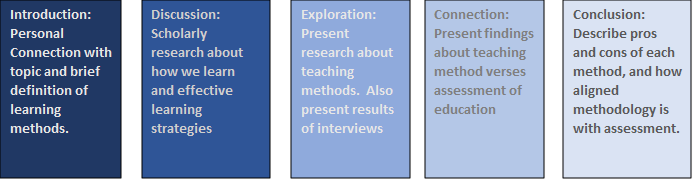
METHODOLOGY
Since a large part of the ideologies I will be exploring are a matter of opinion, it will be important to research from a diverse cross section of educators. Scholarly research, including case studies from educational journals, will inform my basic understanding of how we learn and the philosophies of learning methods. To present variations in opinion of the same terminology and relate them to success in education, personal interviews will be important. I hope to invite several students and teachers, including my own children, to respond to questions about educational ideals. Conducting these interviews will give me a broad spectrum of opinions about what education is and how to approach it.
PROBLEMS
I foresee my biggest problem to be defining terms. “Education” and “Learning” can mean two very different things for different people. Another problem will be backing my claims with credible sources rather than anecdotal. I need to be clear when I am addressing credible sources and when I am discussing someone’s opinion. I also need to be wary of researching tangents or losing focus on my thesis. Another problem could be bias. I want to present honest research. I need to make sure my interview questions don’t lead others to specific conclusions but encourage them to offer their opinion, although it may not agree with my own. I also foresee people being unavailable to interview. To remedy this, I plan to ask more people than I need to. If only a small percentage respond, it would still be enough for my purposes.
ANNOTATED BIBLIOGRAPHY
Adey, Philip, and Bill Lucas. “Should Schools Teach Children How to Learn?” RSA Journal, vol. 149, no. 5503, 2002, pp. 50–52. JSTOR, http://www.jstor.org/stable/41379297. Accessed 23 Jan. 2023. A forum discussing what it means to learn to learn, followed by a Question and Answer session.
Demille, Oliver. A Thomas Jefferson Education: Teaching a Generation of Leaders for the Twenty-First Century. First paperback edition. TJedonline.com 2009 Describes a classical education philosophy with a focus on learning to love learning.
Goldberg, Lazer. “Learning How To Learn.” Science and Children, vol. 19, no. 7, 1982, pp. 10–11. JSTOR, http://www.jstor.org/stable/43148754. Accessed 23 Jan. 2023. Observations of the learning styles of young children and a comparison of teaching styles in the classroom.
Letteri, Charles A. “Teaching Students How to Learn.” Theory Into Practice, vol. 24, no. 2, 1985, pp. 112–22. JSTOR, http://www.jstor.org/stable/1476425. Accessed 23 Jan. 2023. Case study written by a cognitive psychologist helping a young girl develop her reasoning skills to improve her academic success. He also describes the scientific processes of the brain when learning.
Originstutoring.com. “Cognitive Abilities Test (CogAT).” Accessed 27 January 2023. https://www.originstutoring.com/blog/cognitive-abilitites-test Description of the cognitive abilities test, an assessment given in schools to determine the intelligence potential of children.
Robinson, Ken. “Bring on the Learning Revolution!” YouTube, uploaded by TED talks 15 September 2015 https://youtu.be/kFMZrEABdw4 Lecture about the ineffectiveness of some learning processes.
Robinson, Ken. “Do Schools Kill Creativity?” YouTube, uploaded by TED talks 6 January 2007 https://youtu.be/iG9CE55wbtY A comparison between creativity and school lessons.
Robinson, Ken. “How to Escape Education’s Death Valley.” You Tube, uploaded by TED talks 10 May 2013 How to escape education’s death valley | Sir Ken Robinson A discussion of what implementations are necessary for learning to flourish.
TIMETABLE AND SCHEDULE
| Monday 23 Research | Tuesday 24 Research/ Draft Research proposal | Wednesday 25 Research/ Submit Research proposal draft to discussion board | Thursday 26 email associates | Friday 27 Finish Research proposal Draft Saturday 28 Turn in research proposal |
| Monday 30 Email associates/ research/ begin outline | Tuesday 31 Research/collect data/ continue outline | Wednesday 1 Research/collect data Finish outline/begin rough draft | Thursday 2 Write rough draft Assess interview responses (send thank you’s) | Friday 3 Submit research paper draft to discussion board Saturday 4 Give peer reviews |
| Monday 6 Polish rough draft/ visit writing center | Tuesday 7 Edit rough draft | Wednesday 8 Submit rough draft 2 to discussion board | Thursday 9 Revise rough draft | Friday 10 Proofread/edit final draft Saturday 11 Submit final draft |
REQUEST FOR APPROVAL
Understanding how to learn will have a big impact for me whether I teach professionally or not. Having a broader understanding of how to absorb, integrate, and impart knowledge can be applied to all areas of life and interactions with all people. Given my passion for learning, I would like to use my findings to train or teach educators in some capacity. Trying to understand how people think, and helping others learn, is a step toward understanding humanity in general. I respectfully request approval of my research proposal.
 Hearty Home Heritage