Introduction: Are They Really Learning?
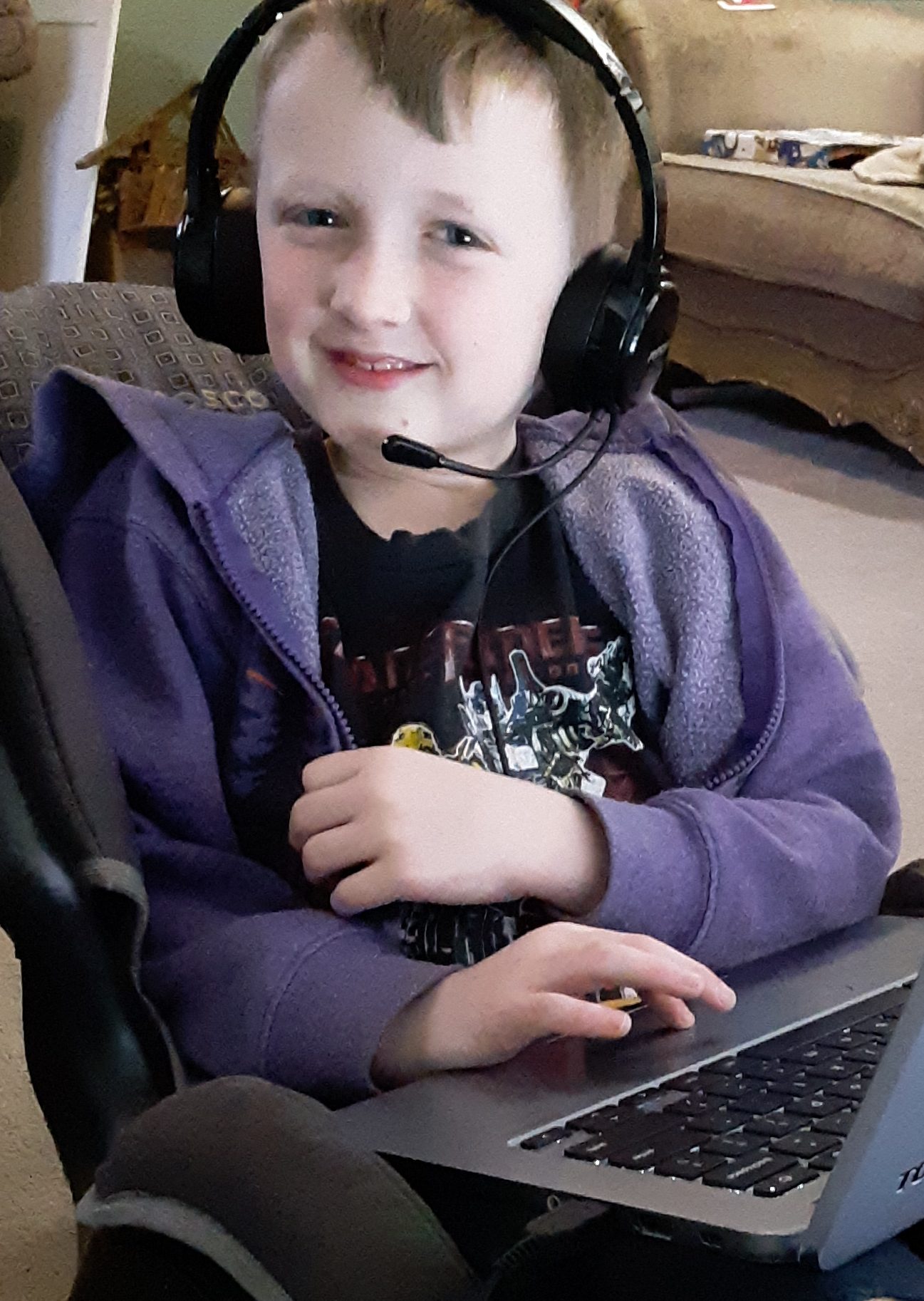
My 8-year-old son, Mason, is sitting in our living room in his little brother’s 5-point harness car seat doing homework for his online class. With his computer, headphones, and microphone, he is working on his business proposal project. Sitting in the car seat, he tells me, makes him feel like an astronaut in a spaceship. He starts asking questions about rockets. How do they get into space? How long does it take to build one? With permission, he turns to an internet search and watches videos of rockets. One is from the astronaut’s perspective, looking back at Earth. He gets a lot of mileage from that one. Now it really is like he is in a rocket! He asks about Earth. What is the name of that continent? How far is that from where we live? What is that swirling cloud over the ocean? Why can we not see cities? We play around on Google Earth before he starts asking about other planets. How far is the nearest planet? How long does it take to get there? What is a light year? What do other planets look like? How far away is the sun? How hot is the sun? I answer his questions the best I can, and we search the internet for the rest. His wellspring of curiosity is inexhaustible. I reluctantly remind him of his assignment. “Oh yeah!” he exclaims, “I almost forgot!” He gets back to it; playing Mozart in the background, he hums along. I watch him, proud of the educational interlude, but with ever-present homeschooling guilt creeping in. There was no way for me to prove “on paper” that he learned. Thus is the conundrum of education. It occurs internally. How is learning measured? Mason learned well enough to spew some facts about planets at the dinner table that night. “That’s cool,” my husband says, “are you learning about the solar system?” Mason shrugs, “We’re talking about business ideas.”
Across the nation, children are educated in various classrooms, engaged in lessons or fighting boredom. Children are presented with similar material, yet the methodologies for education vary. Educators all claim to teach. But do their methods reflect learning? Many homeschoolers, for example, do not track progress with curriculum, tests, worksheets, assessments, or even grade levels, making it difficult to gauge the education received, yet parents claim their child is learning (Grant). Other parents reject homeschooling, yet do not feel satisfied with the educational norms of public school (Averett). As a result, they choose private, charter, or Montessori schools for their family. A vast majority of Americans choose to send their children to public school. Public school’s success measures in some ways are on the opposite end of the spectrum from some alternative forms of education. In public school, all learning is tracked by yearly placement tests, gifted programs, assessments, grades, quizzes, parent/teacher conferences, “teaching to the test,” (Education of the World), and national standardization (Gorlewski 84). Does this tracking truly reflect learning? If so, then public school, as the institution that conducts the most testing is a prestigious choice for education, but testing is only effective if it truly reflects learning. Ken Robinson, an author and international advisor and advocate for education said, “Testing is important. Standardized tests have a place. But they should not be the dominant culture of education. They should be diagnostic. They should help” (Robinson Escaping Education’s 8:43-8:50). No matter the method of education, testing is too often used to unfairly categorize children by intelligence. They unfortunately conclude, rather than begin, learning. In addition, variables, such as poor sleep, low interest, hunger, illness, traumatic home life, or distraction can complicate the learning process and are not always taken into consideration. Effective assessments are individualized— tailor made for the student–a nearly impossible task for educators in a large learning model such as a classroom. Defining what it is to learn and rethinking methods of and reasoning for assessment is necessary, no matter the teaching method. Whether in a public, private, charter, Montessori, or home school, education methods that prioritize engaging learning experiences achieve excellence in education when teaching methods, assessments, and philosophies align with learning.
A Brief History of Education
Before the Industrial Revolution, the upper class educated children at home with private tutors. The middle class educated their children in apprenticeships or trade schools, and the lower class did not receive formal education but worked on farms or in other manual labor. During the Industrial Revolution, public schools were created by government agencies to teach basic literacy to lower classes. Middle and upper classes still used tutors and private schools for the most part, but over time, they diminished, unable to compete with free government funded education. The establishment of public school was not, and is still not, a negative idea. “. . .Delinquency, poverty, and enslavement were replaced with widespread literacy and functionality, with resulting increased prosperity and opportunity” (Demille 22). Education for all lifted the lower class out of poverty, to the benefit of the nation; but it is the lowest and most basic form of education. In other words, public school was meant to be a starting point for education, rather than an ideal. However, most children in the United States today are educated in public schools, and as the progress of the nation is dependent on the education received by the rising generation, public schools should attempt to give students the best quality education they can offer. This is only possible, however, if teaching and learning are compatible. That is—if educators understand how the brain processes information and know how to teach students how to learn.
How Do We Learn?
No student is unteachable. While the task of teaching several unique individuals may seem daunting, it helps to know that individual learning processes are “modifiable” (Adey 50) and can be “augmented” (Letteri 117). Learning can happen in a variety of settings, and in a variety of ways. These variations of the “aspects of intelligence” can be beneficial to a classroom that embraces learning processes (Adey 50). But “what is this slippery, wonderful stuff we’re talking about?” Bill Lucas, Chief Executive for the Campaign for Learning in 2002, asks, “Learning to learn, like learning to love or to live, is complicated” (Adey 50). Definitely the “slipperiness” of learning may be what evades measurement in the classroom.
Charles Letteri, the director of the Center for Cognitive Studies at the University of Vermont, asserts that people struggle to learn because they do not know how the “cognitive structures” of the brain work. In his article, “Teaching Students How to Learn,” Letteri defines learning as a conscious process of using tools of the “information processing system[s] of the brain . . . to modify cognitive structures through assimilation and integration of new information” (113). Like framing a house, the brain requires structures, or previously learned information, to build on (115). When presented with internal or external information, the brain undergoes a process to either accept or reject it. For new information to be integrated into long term memory, it must be connected to an already existing cognitive structure (see fig. 1).

Figure 1-Information processing-general phases and general operations. Source: Letteri, Charles. “Teaching Students How to Learn.” Theory Into Practice Spring 1985. Taylor and Francis https://jstor.org/stable/1476425
Interestingly, memorization, which is often a key tool of education, is helpful mostly in short-term memory. “Memorized material . . . [alone] is not integrated into existing cognitive structures, [and] cannot be said to have been learned” (Letteri 113). An internalized piece of information in long term memory has filtered through not only memorization, but also the more thorough tools of integration found in long term memory, such as making connections, detecting patterns, or creating categorizations. Accepted information is temporarily stored in short term memory while these “various operations are performed,” that integrate it into long term memory. “If an individual is not aware of and does not direct these phases and operations, inaccurate learning will occur” (Letteri 115). In other words, two things are necessary for learning: First, the student needs to be aware that the information exists enough to build connections with it. Second, the student needs to believe he or she can integrate and understand the information, or it will be rejected. Because of this, “teaching to the test,” is not the most effective strategy for education as its main tool is memorization. A student can work for days or even months to memorize what will be on the test and still not internalize the information long term.
Letteri asserts working to enhance cognitive structure is key to learning (115). Consider a toddler in the process of learning to walk. The child is not simply memorizing where his feet are, he is building connections to movement, balance, and his senses that inform him of the process of walking. Letteri states that, “If the cognitive structure is disorganized . . . the new information will not be accurately categorized or assimilated” (115). A poorly framed house will not stand. Poorly formed cognitive structures make learning difficult. Ken Robinson, in his TED talk, “Do Schools Kill Creativity?” points out that learning new things is “dynamic,” meaning that there are several ways in which any one person can integrate knowledge. “. . . . Intelligence is wonderfully interactive. . . . [learning] more often than not comes about through the interaction of different disciplinary ways of seeing things” (13:21-13:42). Teaching methods employing multiple tools of processing and integration will educate students well. Furthermore, schools that adhere to an individualized learning plan for students are encouraging a natural growth of cognitive structures. “. . . . There are conditions under which people thrive, and conditions under which they don’t. We are after all organic creatures, [so] the culture of the school is absolutely essential.” (Robinson “Education’s Death Valley” 16:19-16:28). The methods employed within a school dictate the culture. What is taught and why will enhance or diminish learning. Robinson asserts that allowing students to think creatively is key to helping them access learning. “I think math is very important, but so is dance,” he states, “. . . the most useful subjects for [employment] are at the top [priority]. . . .Benign advice –now, profoundly mistaken” (Robinson Do Schools Creativity? 9:14-11:50). Without building on well-formed cognitive structures, new information may not be helpful to students. In order to ensure that students are learning to the best of their ability, educators must teach them how to learn.
Learning How to Learn
Nothing discussed thus far is groundbreaking information. In a survey of families who have chosen alternative forms of education, conducted for this paper (see results below), most parents and educators expressed the commonsense notion that effectiveness in education is tied to a love of learning and an engaging, individualized educational path. However, the “best” method for learning is harder to pinpoint. What exactly does love of learning look like? A move from “. . .an industrial model of education . . . to a model that is based on. . . an organic process. . . like a farmer, [would] create the conditions under which [students]. . . will begin to flourish” (Robinson Learning Revolution 14:37-15:05).
In 1982, Lazer Goldberg observed a kindergarten class work with play dough. The only instruction was to build a tall tower. Most of the children started with a thick base to build on. Once the towers reached a certain height, they fell, unable to be built higher. After thinking about it, one girl began to build her tower in a spire. The tower grew taller. To source clay without compromising stability, she tunneled a cave in the base. The other children asked her questions and copied her method. Soon many of them had tall, structurally sound towers. “The girl knew nothing about stress, compression, and tension,” Goldberg states, “If this young student’s mind is repeatedly stimulated by similarly appropriate experiences, she will be able to learn whatever she chooses. We will have taught her how to learn” (Goldberg 10). The girl engaged in a truly educational experience because she was allowed not only to think and experiment, building connections in cognitive structures, but also was allowed to question, fail, and try again. The other students working with her learned as well because they were allowed to collaborate as a group. At a Campaign for Learning forum, Professor Phil Adey summed up what is needed to learn how to learn. The first “main pillar” for the development of intelligence is “cognitive conflict,” or the challenge to think through problems and solutions. The second is “social construction, the notion that we make knowledge and understanding together, as a group.” The third is “metacognition,” the practice of thinking and becoming aware of how to form knowledge (Adey 51).
Children who are challenged to think through a solution, to speak and listen with others, and to try multiple solutions are learning. In his study of the kindergarten class, Goldberg determined that simply listening to a lesson on a topic “has little influence on the development of a child’s evolving attitudes. But actively striving to find answers through interesting and significant investigations can engage the whole child, not just a part of his or her mind” (Goldberg 10).
How to Learn vs. Testing
Parents and teachers continue to debate what real education is. Government run schools dictate what children should learn and when by mandating standardization of programs. At the outset, this appears to be a positive thing. Those in favor argue that the same subjects should be taught to all children regardless of location or cultural differences. The contention for families opposed to national standardization is that it replaces the individual’s unique learning path with a “one size fits all” educational standard that is ostracizing millions of students from their creative aptitudes (Gorlewski 84). By separating interests and aesthetic experience from education, school becomes a chore, something children are forced into without regard for their personal motivations. The principles “on which human life flourishes . . . are contradicted by the [current] culture of education under which most teachers have to labor, and most students have to endure” (Robinson Education’s Death Valley 3:14-3:25). To bring equal education to all, governments have effectively digressed the education system to the days of the Industrial Revolution when only the most basic skills were taught to children.
When government funded education systems promote and install tests to standardize learning, valuable discussion is difficult. It is like teaching students to play scales without introducing Mozart. It teaches color mixing without showing a Monet. It teaches the basics without introducing the possibilities. A teacher posted anonymously to the Facebook group “Educators of the World.” Of standardized testing she wrote,
“The curriculum was completely scripted, requiring students to write using a specific format consisting of at least one simple, one compound, and one complex sentence, one instance of multiple modifiers separated by a comma, one simile or metaphor, etc. The idea is to make evaluating writing, a very subjective task, more objective (read: easy for under- trained, low-paid standardized test scorers to evaluate). Apparently, it doesn’t matter if everyone’s paragraph reads exactly the same. I tried to swallow back my disgust . . .”
Intentional learning is the opposite. It focuses more on content than form. The technical aspects of any subject exist to provide structure and organization to the content. “It quickly becomes evident that such an approach is, at best, unjust. At worst, it is ruinous. . . moreover, it is devastating to the dispositions necessary for learning” (Gorlewski 84). Robinson added, “. . .we have sold ourselves into a fast-food model of education, and it’s impoverishing our spirit and our energies as much as fast food is depleting our physical bodies” (Robinson Learning Revolution 13:05-13:11).
Survey of Alternative Forms of Education
Considering the standardization and lower academic standards of schools, it follows that alternative forms of education are gaining popularity (Averette). But are these alternative forms of education effective at teaching? Are students learning? Does their measure of success reflect learning? For the purposes of this paper, families across several different methods of education were surveyed. These results are too small to reflect the sentiments of a national average, but they do give an interesting snapshot of current philosophies of education (see survey.) Some results were expected. A majority of those surveyed felt that their own method of education was the best. This makes sense. They would not choose it if they felt it was ineffective. Some results were surprising. While no one said that testing was the best way to assess learning, almost half said that they used testing in some form in their classroom. When it comes to the difference between the terms “learning” and “education,” most felt that “learning” was a positive term that more closely described integration of knowledge, while “education” was a negative term that connoted stiff formality and forced structure. When asked what the most important thing was to learn, a majority described a “love of learning” as the most important, while a “knowledge of basic skills” scored lowest—the opposite philosophies of public school. Most families measured learning through discussion or life application over grading, which was the least favored method. Nineteen out of the twenty families rated their measure of success as an honest reflection of learning between “neutral” to “extremely well.” These findings indicate that a majority of those who choose alternative forms of education for their children are employing the “cognitive tools” necessary to enable lifelong learning (see survey results here).
Conclusion: But Are They Really Learning?
Since there are many ways to assimilate information, it follows that there can be several successful ways to teach. In my son Mason’s case, he learned both through asking questions about rockets and in his business model project. The key is to teach students standards of learning, not basic standardization. Any school whose priority is to teach students how to learn will have successful students. A school that teaches for any other reason (i.e., for money, prestige, or higher test scores) will likely hinder students’ ability to be successful learners. The future success of the nation depends on the educational success of our students today. Decisions for how and why we educate cannot be more vital. “If we don’t do it, who will? And if not now, when?” (Gorlewski 87).
Somewhere,
something incredible is waiting to be known.
–Carl Sagan
Works Cited
Adey, Philip, and Bill Lucas. “Should Schools Teach Children How to Learn?” RSA Journal, vol. 149, no. 5503, 2002, pp. 50–52. JSTOR, http://www.jstor.org/stable /41379297. Accessed 23 Jan. 2023.
Averett, Kate. “Homeschool Revolution: More Parents Than Ever Are Against Public Schools.” New York Post. 8 May 2021. https://nypost.com/2021/05/08/more- parents-than-ever-turn-from-public-schools-to-homeschool/
Demille, Oliver. A Thomas Jefferson Education: Teaching a Generation of Leaders for the Twenty-First Century. First paperback edition. TJedonline.com 2009
The Education of the World. “A Teacher’s Story: Why I’m Leaving Public Education.” Facebook. 23 January 2012 https://www.facebook.com/permalink.php?story_fbid =603170379705065&id=600551486633621 Accessed 31 January 2023.
Goldberg, Lazer. “Learning How To Learn.” Science and Children, vol. 19, no. 7, 1982, pp. 10–11. JSTOR, http://www.jstor.org/stable/43148754. Accessed 23 Jan. 2023.
Gorlewski, Julie. “Research for the Classroom: Standards, Standardizations, and Student Learning.” The English Journal. May 2013, Vol 102, No. 5 https://www.jstor.org /stable/24484101. Accessed 26 January 2023
Grant, Erin. Survey of families choosing alternative forms of education. Online via email 31 January 2023. Unpublished Survey
Letteri, Charles A. “Teaching Students How to Learn.” Theory Into Practice, vol. 24, no. 2, 1985, pp. 112–22. JSTOR, http://www.jstor.org/stable/1476425. Accessed 23 January 2023.
Robinson, Ken. “Bring on the Learning Revolution!” YouTube, uploaded by TED talks 15 September 2015 https://youtu.be/kFMZrEABdw4
Robinson, Ken. “Do Schools Kill Creativity?” YouTube, uploaded by TED talks 6 January 2007 https://youtu.be/iG9CE55wbtY
Robinson, Ken. “How to Escape Education’s Death Valley.” You Tube, uploaded by TED talks 10 May 2013 How to escape education’s death valley | Sir Ken Robinson
 Hearty Home Heritage